Meshtastic
Meshtastic is an open-source project that uses LoRa (Long Range radio) technology to enable the creation of autonomous mesh networks. This means Meshtastic devices can communicate with each other without needing a central server or an internet connection. This is particularly useful in places where there is no reliable mobile network or internet.
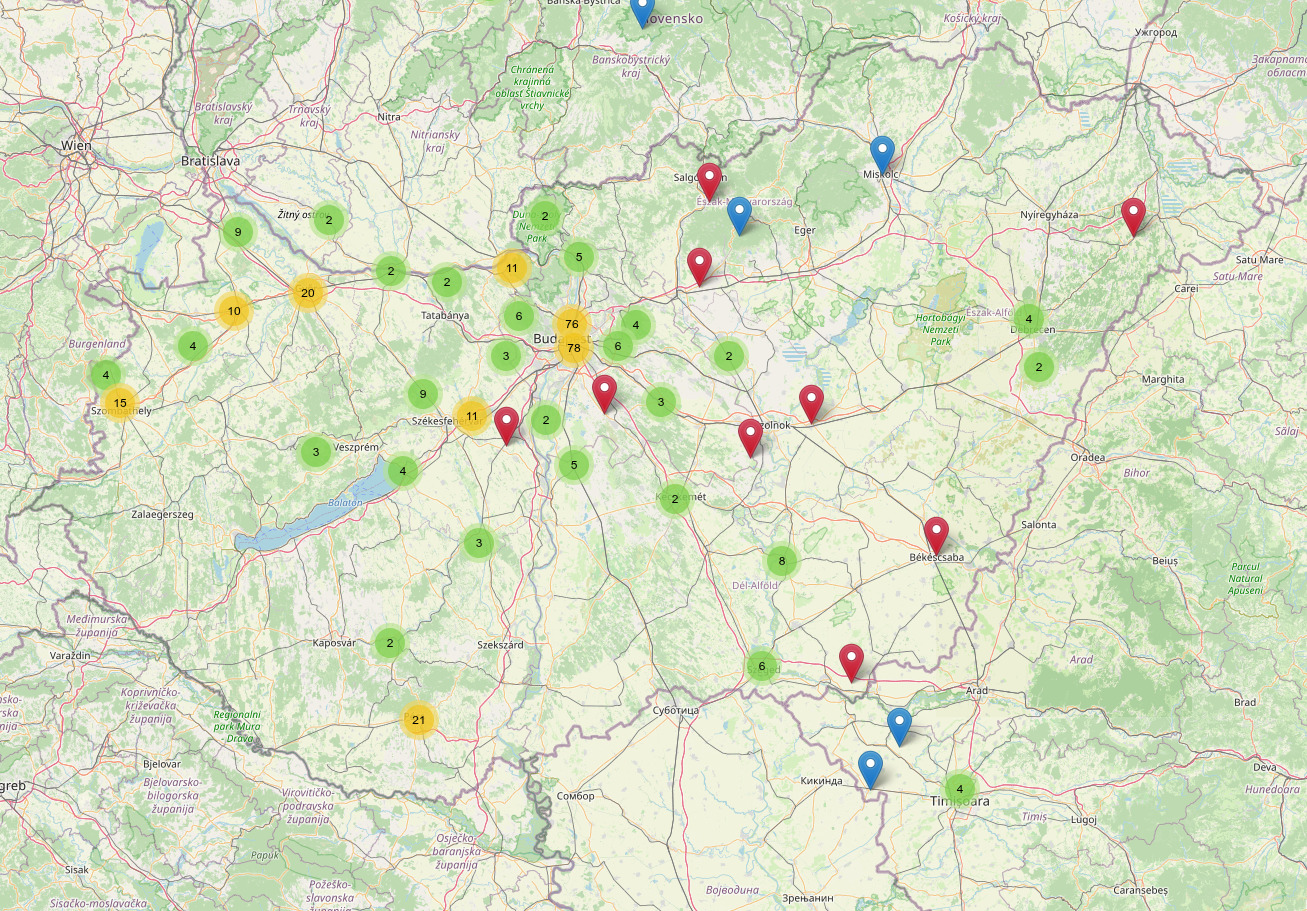
Or when those are deliberately shut down.
What is LoRa?⌗
LoRa is a wireless communication technology that promises long range at low power consumption. Devices can communicate with each other over distances of several kilometres while using minimal energy. LoRa technology is particularly well-suited for applications where long-range communication and low power draw matter, such as agricultural sensors, urban infrastructure, or emergency communications.
It operates on freely available frequency bands (433 MHz, 868 MHz in Europe, 915 MHz in the US), so no licence is required to use it — though transmit power and communication speed may be limited by local regulations (typically well below 1W).
LoRa itself only defines the physical layer, which specifies how radio communication happens. The network layer and protocols, however, can vary depending on the use case.
LoRaWAN (LoRa Wide Area Network), for example, is primarily used in IoT (Internet of Things) applications — agriculture, industry, remote sensor readout — where a central network server manages communication between devices. Meshtastic and MeshCore, by contrast, create a peer-to-peer mesh network where devices communicate directly with each other, without needing a central server.
Power consumption obviously also depends on how the technology is used, but for example “dumb” soil moisture sensors can run for years on a single 1.5V AA battery.
Meshtastic⌗
In Hungary, of the two more popular LoRa-based mesh networks, Meshtastic is currently more widespread — compared to MeshCore, which is a newer project with a smaller community and a more technical bent — so I wanted to try that one first.
The basics of Meshtastic⌗
- Fully decentralised
- Encrypted communication
- Text messages, location sharing, and other data transmission (temperature, humidity, etc.)
Devices⌗
Meshtastic devices typically consist of a LoRa module, a microcontroller (e.g. ESP32), and a battery. Many varieties exist: there are so-called “companion” devices that connect to a smartphone via Bluetooth; some have a display, some don’t; there are “dumb” devices for GPS tracking only; and there are devices that look almost like a small phone with a keyboard, allowing you to send and receive messages on their own.
How it works⌗
Flooding⌗
In the network, every device (that is configured to do so) tries to forward messages to other devices until they reach their destination.
- The sending device transmits the message with a hop limit set on it (maximum 7)
- A receiving device gets the message, and if it is not the intended recipient, hasn’t seen that packet before (identified by packet ID, stored in a sliding window cache), and the retransmission count hasn’t yet reached the hop limit, it forwards the message to other devices
Encryption⌗
On first use, every device generates a key pair and shares its public key with other devices (via regular “nodeinfo” broadcasts). Direct messages are encrypted by the sender using the recipient’s public key, so only the recipient can decrypt the message using their own private key. Forwarded messages are received by every device along the way, but they cannot decrypt them and therefore cannot see their contents.
Messages on shared channels are also encrypted, so the network remains secure even if someone attempts to intercept the communication. (Channels require an encryption key to join — on public channels this key is known to everyone, but messages sent to them are still encrypted; it’s just that anyone can decrypt them.)
MQTT bridge⌗
While entirely optional, it is possible to configure an MQTT bridge that forwards messages to a central server, making them accessible through a web interface. This can be particularly useful in locations with internet connectivity where you want to monitor or control the network from a central point.
The bridge can theoretically also be used to connect two physically separate networks, though this is not a very common use case (and obviously compromises the “autonomy” aspect).
My own setup⌗
I started with a Seeed Studio T1000E and a Heltec T114, both of which I can carry with me — both run on the nRF52840 microcontroller, which consumes significantly less power than ESP32-based variants. My original plan was to take one of them running with me, so people could track my position even in areas without mobile coverage.
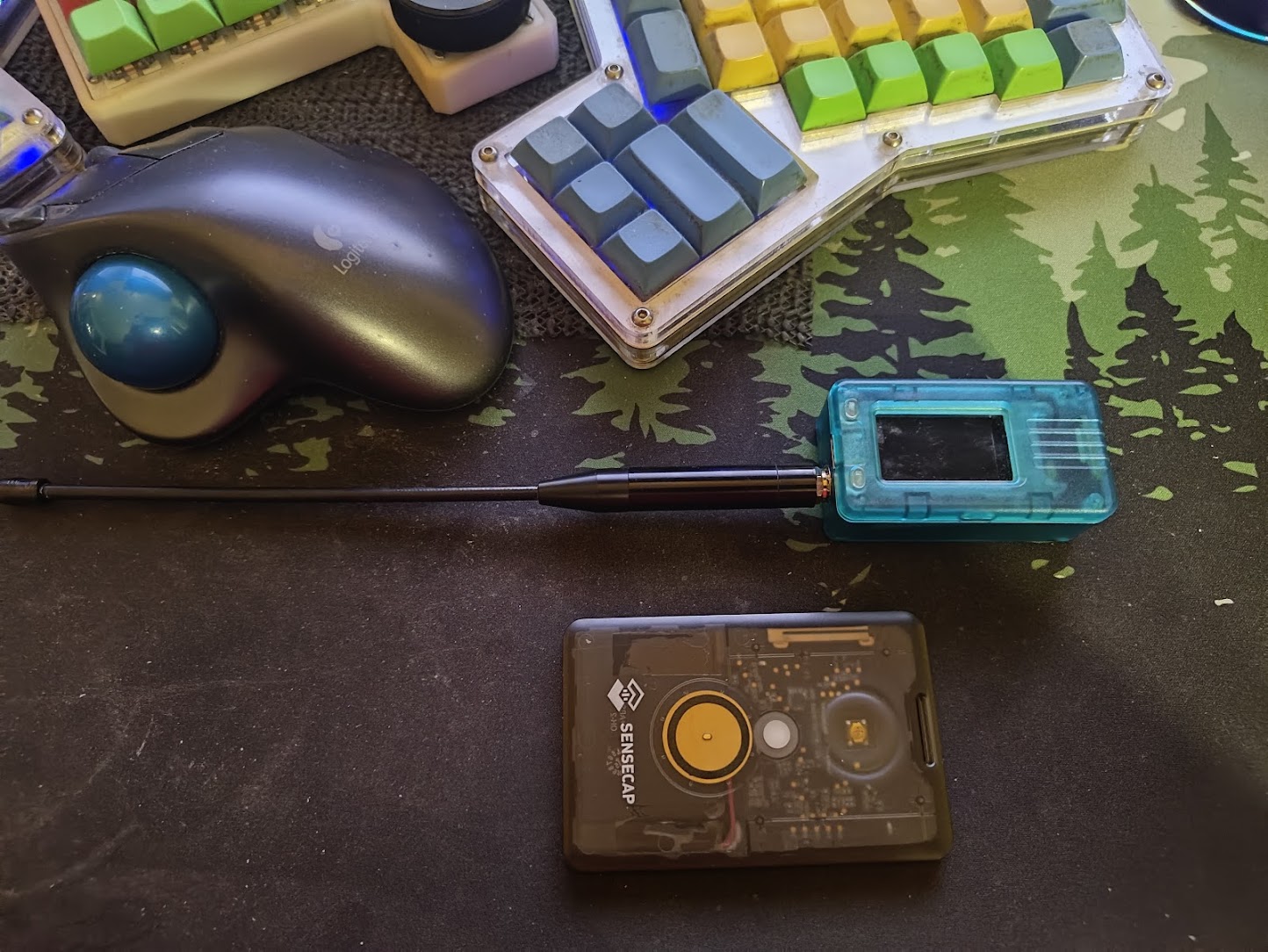
In a first larger test in the Pilis hills, it performed well — position reports came through even from the Apátkúti valley. The Pilis is particularly well-covered, and at the time the Hungarian community was using the “LongFast” preset, which was better for coverage than the currently used “MediumFast” (the community switched to the latter because the network in Budapest was starting to get congested).
A preset is a predefined set of settings that determines the parameters of LoRa communication, such as speed, coding rate, bandwidth, etc. These parameters affect the range and power consumption. For example, the “LongFast” preset provides longer range at lower data transmission speed, while the “MediumFast” allows for faster data transmission at shorter range.
A more detailed explanation of the parameters can be found in the Meshtastic documentation.
At home, though, nothing showed up (Budakeszi is quite shielded, especially from the direction of Budapest and the Pilis), but I did receive messages while running in the area, so I decided to put a node on the rooftop to improve local coverage. That became a Heltec V3 (ESP32-based, powered from mains). Even that wasn’t enough — despite fitting it with a larger (4 dBi) antenna, I barely saw anything beyond the occasional stray packet (probably forwarded by someone passing through the area).
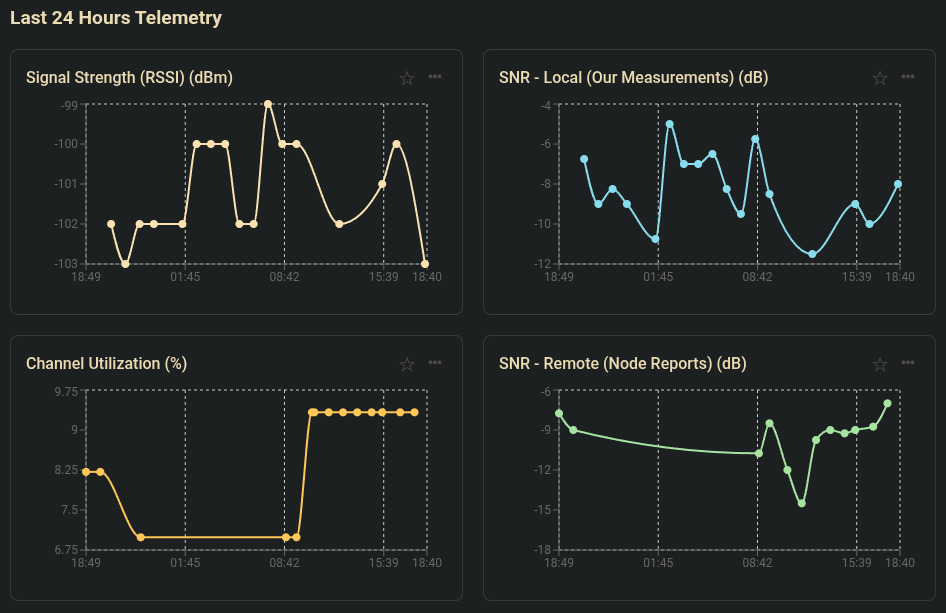
The breakthrough came last Tuesday, when an AB-IOT amplifier I ordered from AliExpress arrived — now I can both see and be seen. :) With a single node I have a stable link to one that sits on a peak in the Gerecse, about 40 km away, so the range really is something else. The connection is surprisingly stable even though the signal strength is around -100 dBm and the SNR (signal-to-noise ratio) is around -10 dB, which don’t look like impressive numbers at all. A traceroute initiated from Normafa (~2.5 km away) travelled more than 100 km before it got back home. :)
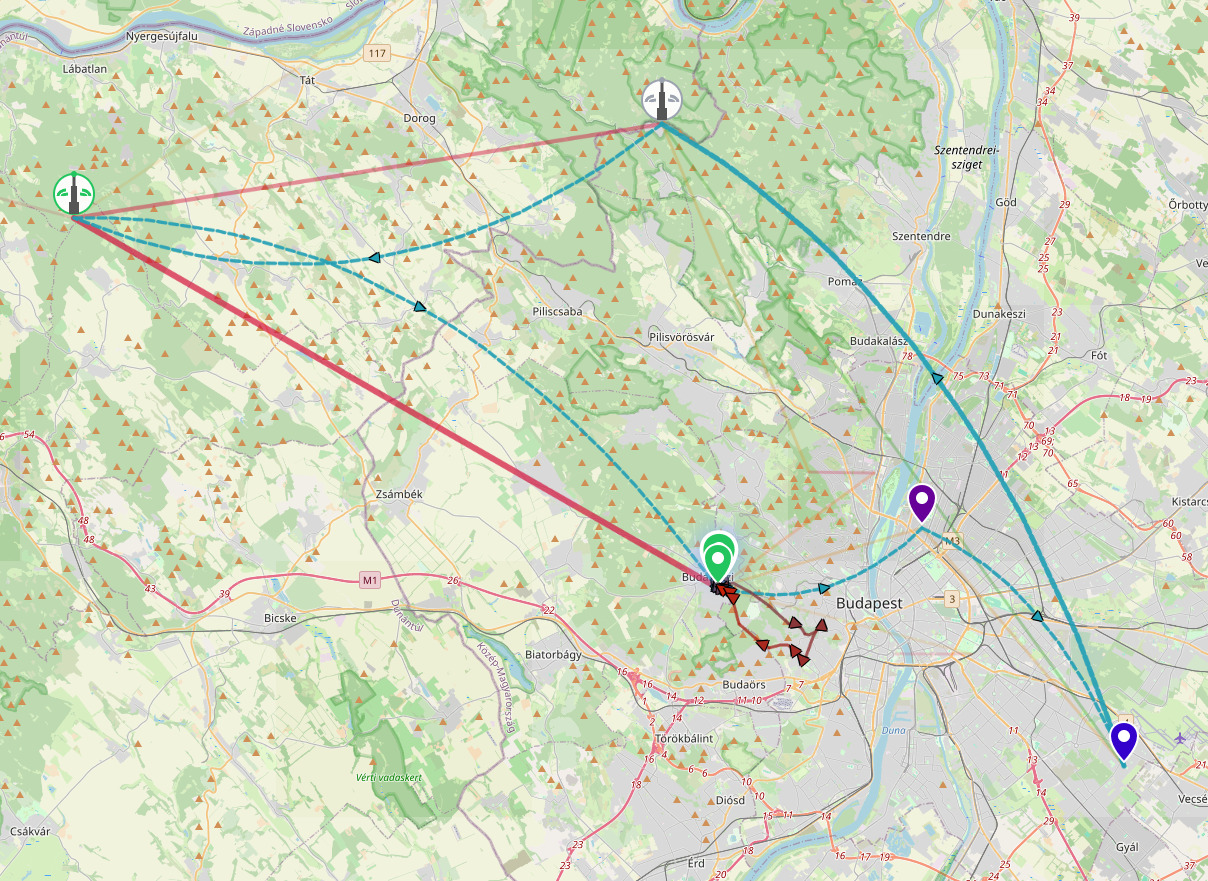
I also ran a few traceroutes toward more distant nodes and found that 38 km is far from the limit — nodes with good antennas, amplifiers, and filters can do significantly more.
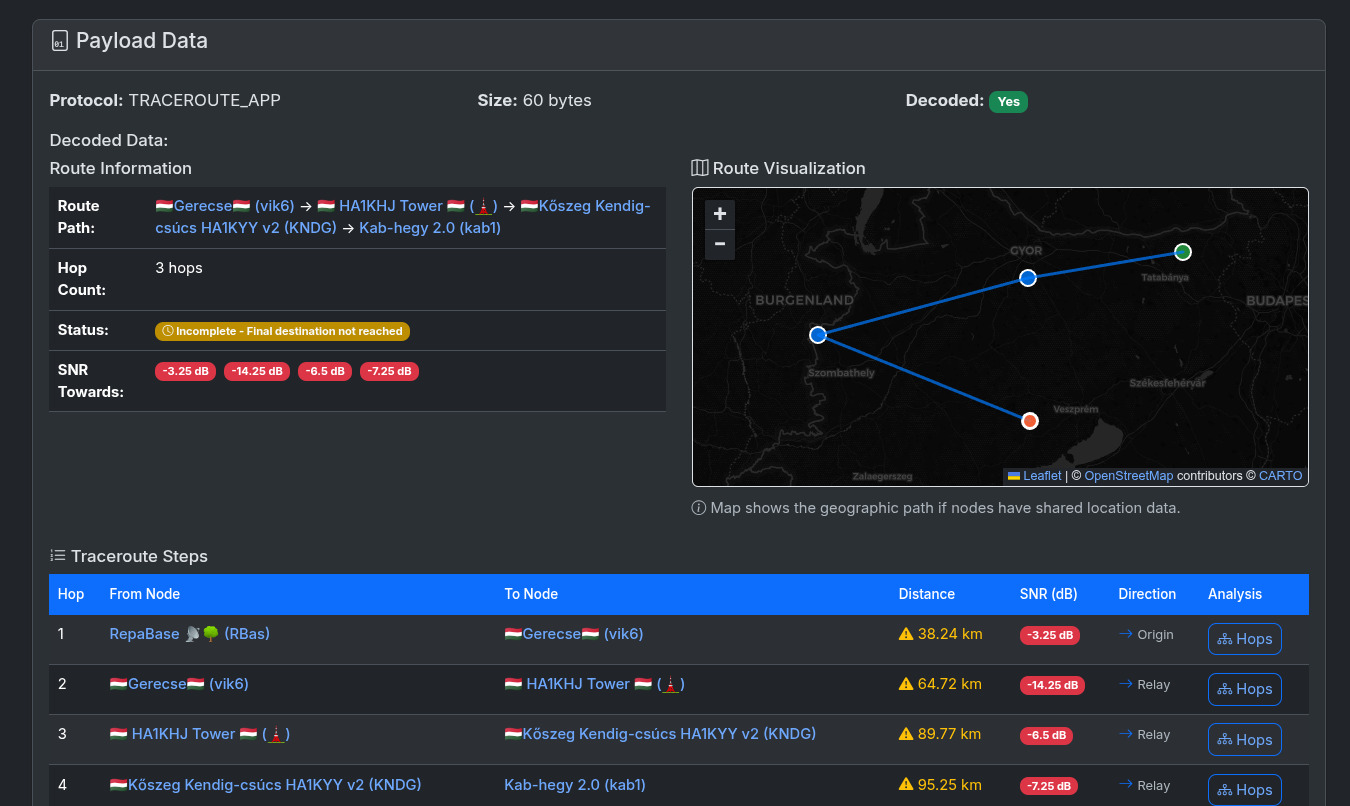
A solar-powered node on the Csergezán Pál lookout tower would help a lot, but unfortunately it was closed at the end of last year, so I haven’t even started asking around about how to officially install something there.
The Hungarian community⌗
The Hungarian mesh community, while not large, is definitely bigger than I initially expected. :) At the moment coverage is concentrated around Budapest, Northern Transdanubia, and a few larger cities, but new nodes are appearing every day, so the situation can change quickly.
Current settings can be found on the Hungarian Meshtastic community website, where there is also a map showing where nodes are located and how likely you are to be able to reach them.
Also worth checking out is the MQTT data collection site, where you can monitor network traffic and see which nodes are communicating with each other.
Since the mesh is far from complete, and because of the 7-hop limit not everyone would necessarily see every message anyway, communication also happens on Discord (yeah, I know…), where there’s always someone who can help if you get stuck with the configuration.
OK, but what is all this actually good for?⌗
- Off-grid communication in the middle of nowhere — hiking, or places with no mobile coverage (or “survival trips” where you’re not allowed to bring a phone)
- Tracking cars, motorcycles, or escape-artist dogs via GPS without any subscription fees
- Emergency communication during floods, earthquakes, and similar events
- Building community networks in places without reliable internet
- Experimentation, learning, and getting to know the technology
- But seriously — an off-grid, autonomous, encrypted communication channel that’s difficult to even detect due to its low transmit power, if you don’t know exactly what to look for… in a word: for preppers :)
Original post in hungarian: here, english translation mostly done by Claude.